Showing posts with label blue. Show all posts

Thursday, August 18, 2016

Seiko Superior SSA001 Flight Computer "Cyclops" in Blue

Truth be told, I'm a fan of dive watches. So much so, that I have a whole slew of them ranging from Seiko SKXs, to Oris Aquises (see my review of the Oris Aquis Date here), to the Marinemaster 300. I haven't quite reached Rolex Submariner level yet, but it's definitely on my list assuming a ton of money goes my way someday.

Pilot watches, on the other hand, to me at least, are a mixed bag. I do admire pilot watches' emphasis on legibility and functionality even if they do not possess the ruggedness or tool-watch vibe of dive watches, with the latter being purposefully overbuilt to withstand extreme depths. It is that lack of ruggedness though, which ironically makes them more convenient as daily wearers, as they are typically lighter, easier to dress up with leather straps, and possess the at-a-glance legibility that is not only convenient for pilots, but for anyone in general. 
 
As such, while my collection mostly focuses on dive watches, there are a precious few pilot or aviation-themed watches in my collection. There is the Hamilton Khaki Aviation Pilot Day Date Auto (see review here), and then there is Seiko's line of Flight Computer slide rule watches, affectionately dubbed by Seiko fans as the "Cyclops".

The subject of this review is the blue version, the Seiko Superior SSA001, first introduced in 2011.

SSA001 Flight Computer, AKA "Cyclops".
A single glance of the SSA001 reveals the volume of functionality crammed into a 44mm case diameter, 13mm thick, and 50mm lug-to-lug length package. First to be noticed is the massive dial face with applied stick indices all the way around, with a pair of stick indices denoting the 12 o'clock position. There is a silver 24-hour subdial just below it, indicating at a glance military time or whether the current time is in AM or PM. It is this subdial which is essentially responsible for earning this watch the "Cyclops" nickname, given its very prominent location on the dial.  There is a date aperture with a silver border at the 4 o'clock position, displaying a high contrast date wheel consisting of white numbers on a black background. The hour and minute hands are slim, white bordered fencepost-styled ones which display excellent legibility against the dark blue waffle dial, while the second hand is arrow-styled with the tip in high contrast white. The indices, hour, minute and second hands are all generously filled with Seiko's proprietary Lumibrite compound, so lume performance is right up there with the best of them. There is minimal text on the dial, consisting of an applied "SEIKO" logo at the 3 o'clock position just above the date aperture, and "AUTOMATIC" and "100M" text printed halfway between the middle of the dial and the 6 o'clock index.  Surrounding all these dial elements is a precisely printed minute track chapter ring with hash marks every five minutes, every second, and every fifth of a second, and topping off the entire dial is a domed Hardlex crystal.

The 100m water-resistant case features a mix of brushed (on the top) and polished (at the sides) surfaces which gives the watch a dressy demeanor, though that impression is quickly tempered by the no-nonsense appearance of the bi-directional rotating slide rule which can be used in the calculation and conversion of various flight data, such as distance, altitude, fuel weight and volume. It is this feature which is responsible for the "Flight Computer" moniker, though to be honest I've never figured out how to use this myself, but then again I'm no pilot. The rotating outer bezel is in blue with gilt text while the stationary inner bezel is in polished steel with black text.
 
Powering this watch is Seiko's 24-jewel, 21,600 bph, 4R37 hacking and handwinding movement, a variant of the ubiquitous 4R36 movement which eschews the day complication for a 24-hour subdial. Performance is virtually identical to that of the 4R36, with a 41-plus hour power reserve and accuracy of +/- 30 seconds a day. Setting the time is accomplished through a non-screw down crown at the 4 o'clock position which features a blue ring to complement the rest of the blue of the watch. The minimally finished movement is visible through a see-through caseback.

The bracelet is perhaps one of the few weak points of this watch, with hollow end-links, split-pins, and a stamped-steel clasp. In typical Seiko fashion, the bracelet, which is mostly brushed with polished center highlights, is functional and adequate, but not much else. Those unsatisfied with the supplied bracelet may opt to use original Seiko or aftermarket rubber, leather, NATO or Zulu straps, thanks to the standard 22mm lug width.

All-in-all, the SSA001 is a unique spin on pilot watches done in Seiko's distinctive style. Even without the brand on the dial, there is no mistaking this watch for anything else other than a Seiko, and this has contributed to the following that this watch has. The looks may not appeal to everyone, but they have a strange way of warming up to you the longer you stare at it.

This watch can be bought new for 200-220 USD assuming you can still find one for sale.

More photos:


Wednesday, August 17, 2016

2007-2013, 2015-Present Longines HydroConquest in Blue L3.642.4.96.6

The HydroConquest is a relatively affordable line of Swiss dive watches produced by Longines since 2007. The line went relatively unchanged until 2013, when a fully Arabic dial version of the HydroConquest was launched (see my earlier review here). Curiously, after only two years, that version was dropped and the original iteration introduced in 2007 found itself back in Longines' catalog. It is this current version, in blue, which is the subject of this review.

2007-2013, 2015-Present HydroConquest.
The 2007-2013, 2015-present HydroConquest bears a lot of similarities with its 2013-2015 brother, but both have unique design elements that makes it virtually impossible to confuse one over the other. The most obvious difference is in the dial.

The current dial features applied numeric markers on the 12, 6, and 9 o'clock positions, and similarly applied circular and linear indices for the rest of the hours. These dial elements give the watch face a more upscale demeanor than the printed Arabic numerals on the 2013-2015 HydroConquest, though at the expense of simplicity, as the overall appearance can come across as being quite busy. Tastes obviously vary,  and I personally like both dial styles, though I have to admit the 12-6-9 dial strikes me as being a tad more eye-catching, perhaps in part to the sunburst blue dial.

Dimensions (41mm case diameter, 50mm lug-to-lug, 11mm thickness, 21mm lug width) as well as most other design details of the watch head are similar, from the applied Longines winged logo, the date window at 3 o'clock, the beveled and rhodium-plated  hands, the snowflake hour hand, the red-tipped lumeless second hand, the polished sides and brushed top, the angular crown guards surrounding a highly polished crown, up to the highly detailed engraving of Longines' hourglass logo on the caseback. Topping off the entire package is a 120-click rotating dive bezel with an aluminum insert and a sapphire crystal with anti-reflective coating.

The bracelets are basically similar in design, use of split pins and the lack of half-links and all, though the finishing is different. The 2013-2015 HydroConquest's bracelet is brushed all the way, while the current HydroConquest features polished center links, contributing to its slightly more upscale vibe.

Lastly this version of the HydroConquest uses an Elaboré grade ETA 2824-2 L633 movement, instead of the ETA 2892-A2 based L619 in the 2013-2015 model. The 2892-A2 movement is generally considered to be slightly higher end than a 2824-2, but for this implementation, hardly any differences in performance can be perceived.

So, which one to get? Both versions have their advantages and disadvantages, but the main point for deciding to go one way or the other has to be the preference for the dial design. The 2013-2015 HydroConquest has a cleaner, simpler design with the use of printed Arabic numerals, at the slight expense of looking like an ordinary field watch. The current model has a more distinctive and more upscale appearance, at the slight expense of design simplicity, with perhaps too many design elements on the dial itself.

Overall, despite the "Hydro" in the model name and the 300m water resistance rating, this watch is seemingly more of a desk diver than an actual tool diver, for the same reasons given in my review of the 2013-2015 HydroConquest, particularly in regard to poor lume performance, an unlumed second hand, the smooth sections of the timing bezel, and the oversized, sharp-edged crown guards.

From the perspective of a desk diver, it is more than up to the task, and despite its design shortcomings, it is still a fully capable dive watch.

While the 2013-2015 model seems to have been discontinued, it is still somewhat relatively easy to come by with new stocks still available, not to mention their availability in the second hand market. Because of the relatively short production run, it is speculated that the older version may very well end up as a collector's item or a future classic. While that may or may not happen, the current model is no slouch itself in terms of appearances. You won't go wrong regardless of version you opt for. Price for the current version is around 1,000 USD from authorized dealers or online retailers, but you can likely get one at a lower price if you look around.

In a future post I'll making a more detailed photographic comparison between the two HydroConquest versions. For now, here are some more photos of the current model:


Thursday, August 11, 2016

Seiko SRPA21 Special Edition Pepsi "PADI Turtle" Reissue

It took it's own sweet time getting here, but the special edition PADI "Turtle" has finally arrived:

SRPA21 "PADI Turtle".
I won't be boring you with the specifications, dimensions, or other technical details of this watch considering that I have discussed this several times before in my reviews of the other "Turtle" reissue variants, starting with the SRP777 Black "Turtle", the review of which can be found here.

What this variant has going for it is it's unique color treatment and the PADI logo, a nod to the Professional Association of Diving Instructors, a renowned diving organization which teamed up with Seiko in promoting the project AWARE ocean protection program.

It features a blue sunburst dial, white-lumed indices with silver surrounds, a dark blue chapter ring with a white minute track and red hash marks every five seconds. The chapter ring in this particular sample, in typical Seiko fashion, is slightly misaligned, but not significantly so to be distracting. The bezel is predominantly blue with a red portion extending from the twelve o'clock position up to the 20 minute mark. The Prospex insignia, love it or hate it, has moved from below the center of the dial in the other Turtle variants, to above it, making way for the PADI logo prominently emblazoned in its own distinctive font. The minute hand sports a red border, making it stand out from the rest of the dial, enhancing what is already a very legible overall package. This variant comes with a stainless steel bracelet.

All-in-all, this is a far cry from the color scheme of the original Pepsi SRP779 (see review here) which shares its black dial with the SRP777, it's only claim to the "Pepsi" moniker being  a Pepsi bezel using a shade of blue darker than the one on the PADI variant. Honestly, of all the reissued Turtle variants I've seen in the metal, this is hands down the most visually appealing.

This watch has been hyped quite a bit ever since rumors of its existence first surfaced early in the year, and as a result there has been a lot of anticipation with regard to its release. This anticipation has caused launch prices here to rise way above the levels of the other variants when they first came out. Being a special edition, production will be continuous, though there have been reports that distribution will be limited both in numbers and availability in some areas.

Locally, the SRPA21 can be purchased, assuming you can find one, for the equivalent of anywhere from 280 to 430 USD for the "K" models, and even up to 640 USD for the "J" models. Good luck finding one though here, as most have been snatched up by Seiko aficionados and collectors in less than a day after being made available. Time will tell though if availability, and prices, will settle down.

What is certain though, is that this is bound to be a much sought after future classic.

More photos:


Note the slight misalignment of the chapter ring.

Sunday, March 13, 2016

Seiko SRP787 Black/Blue "Turtle" Reissue

Seiko dive watch fans in this part of the world are fortunate again in that we have first dibs on new members of the "Turtle" reissue series, a few months before they are scheduled to be made available in other territories. Most Seiko aficionados recall that the initial release of the new series of SRP77x divers paying homage to the iconic Seiko 6306/6309 happened here in Southeast Asia around late November or early December last year, at least a full month before these were made available anywhere else. Now, at least two months before the announced official release date of May 2016, available for purchase from authorized dealers here are two new members of the reissued "Turtle" family, the SRP787, and the SRP789.

In case you're not yet familiar with this particular line of Seiko dive watches, the key details include a case and dial design harking back to the old cushion-style 6306/6309 divers produced from 1976-1988, ISO 6425 dive watch certification, 200m water resistance, use of Seiko's workhorse movement, the 24-jewel hacking/handwinding 4R36 which runs at 21,600 bph with a 41 hour power reserve, and hands reminiscent of the hands used in the iconic SKX007/009 line of divers. Dimensions are 45mm (excluding crown) x 14mm x 48mm, with a lug width of 22mm.

For more details on this particular range, you can refer to my review of the SRP777 Black "Turtle" reissue here, or my reviews of the other earlier released variants, the SRP773, SRP775 and the SRP779.

This post will be focusing on the black/blue variant, a color scheme often referred to as "Batman", based on the color scheme of that particular comic book character. The watch is predominantly black, similar to the SRP777, but with a solid end-link stainless steel bracelet with dive extension same as the SRP773 and SRP775. The bezel is blue up to the 20 minute mark, and black the rest of the way. The minute hand sports a blue outline, making it stand out more visually from the rest of the dial. I would expect these new models to be popular given that the changes would likely appeal to those into modding.

Locally they are priced anywhere from 260-310 USD. I would expect these to be priced a bit higher in other territories when they are made available there.

Some photos:
SRP787, AKA "Batman Turtle".


Friday, March 11, 2016

SRP707 on Hirsch

In an earlier post I've written and posted photos of my Seiko Neo Sports SRP711 on a Hirsch leather strap. Decided that my SRP707, the sunburst blue-dialed version of the SRP711 (see earlier review here), could also benefit from the aesthetic improvements from a high-quality leather strap, as opposed to the rather bland appearance of the stock stainless steel bracelet. This time I used a 22mm brown Hirsch Forest Artisan leather strap, and I'm quite pleased with the way it turned out.

Have a look:


Friday, February 26, 2016

Seiko Neo Sports Blue SRP707

I recently wrote about Seiko's recent line of Neo Sports field/military inspired watches (see the earlier post of the SRP713 here), and this follow up post focuses on the SRP707, the SRP713's blue-dialed sibling.

The SRP707 is identical to the SRP713 except for the adopted color scheme and the use of a stainless steel bracelet instead of a leather strap. This model features white dial markings on a very distinctive and eye-catching dark blue sunburst dial. Hands are white as well, and the second hand is black with a third its length up to the tip painted white. The day/date window is bordered in white, with the day/date wheels consisting of white text on a black background. The fixed coin-edge bezel is brushed, in contrast to the polished finish on the SRP713.

The stainless steel bracelet is a basic single fold-over clasp type with a pinch lock, measuring 22mm at the lugs and tapering down to 20mm at the clasp. End-links are hollow, and the links are secured with split pins. The clasp is signed with the Seiko brand, and only has two micro-adjustment holes, so finding the right fit may be tricky for some.

It's pretty much a variation of the theme, but personally I may consider some aftermarket straps instead of the stock bracelet.

Some photos:

SRP707.


Sunday, February 14, 2016

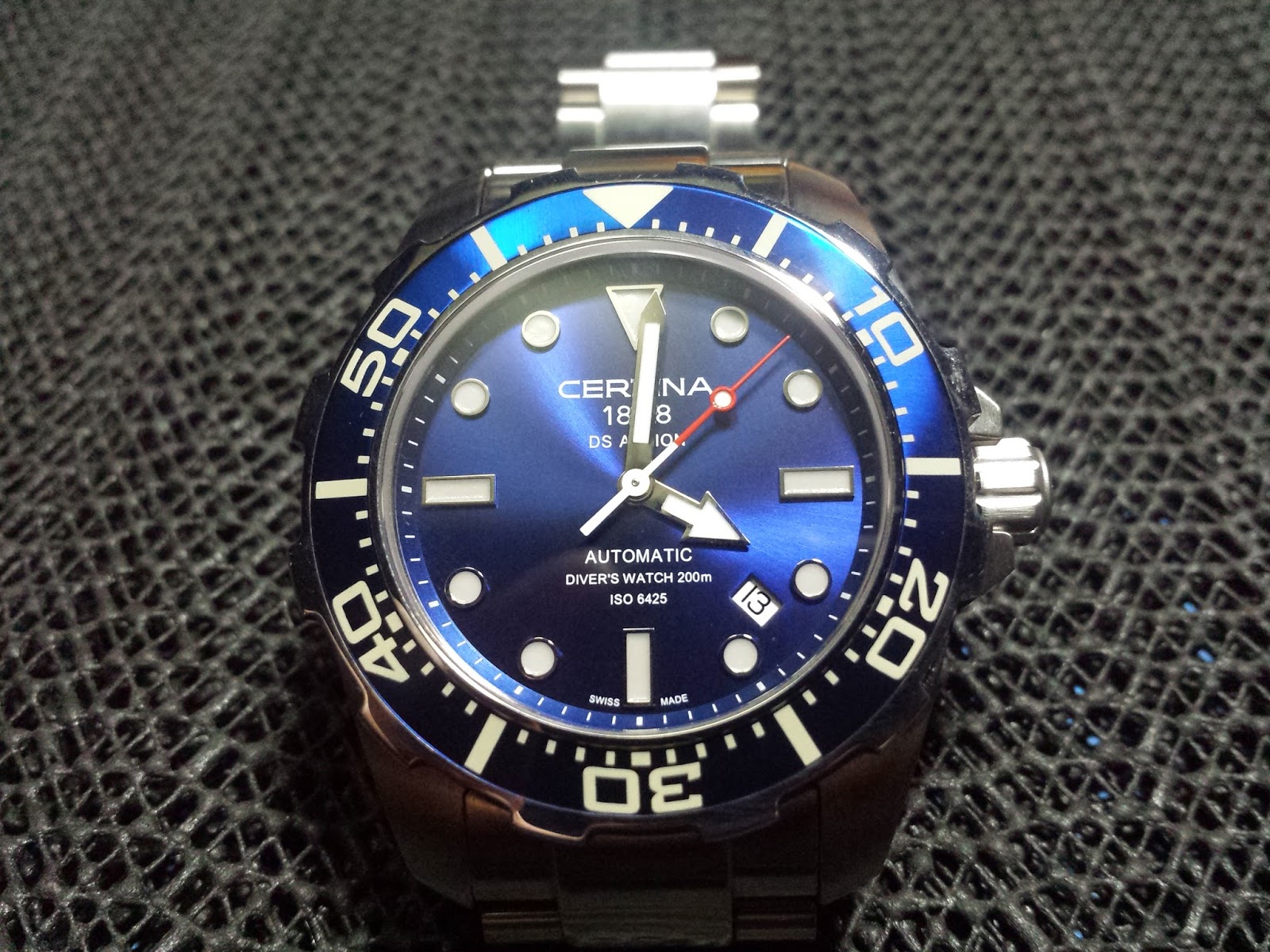
Certina DS Action Diver in Blue C013.407.11.041.00

For today I will be posting photos of the Certina DS Action Diver in blue. A review of this timepiece's black sibling is posted here, and virtually everything in that review applies to this model as well.

The only differences between the blue and black models are the colors of the dial, bezel insert and date wheel. While the black DS Action Diver has a glossy black dial and bezel insert, this model has a glossy blue sunburst dial and bezel insert instead. What's unique about this model's shade of blue is that it warms up depending on the lighting and angle you are looking at it, ranging from cobalt blue, to royal blue to almost violet. This is in contrast to the Blue Oris Aquis Date (reviewed earlier here) where the matte dial takes on a cooler shade, almost bordering on gray in certain angles.

The date wheel adopts a color scheme the reverse of that on the black DS Action Diver, with black numerals on a white background.

Here are some photos:

DS Action Diver.


Saturday, January 30, 2016

Oris Aquis Date in Blue 01 733 7653 4155-07 8 26 01PEB

Oris is a rare breed among Swiss brands. There simply aren't that many relatively well known, independent Swiss watchmakers with a design aesthetic truly unique to themselves, and not derived nor shared, with any other. The majority of it's timepieces are priced in the realm of reality, not artificially bloated in order to jack up the prestige of the brand, nor devalued to avoid crossing into some arbitrary market segment or competing with a stablemate brand.

None of that nonsense here. As Oris' tagline goes, real watches for real people.

Case in point is the subject timepiece for today's review, the Oris Aquis Date 300m dive watch, first introduced in 2011. Just one look at the watch and one cannot help but be struck by it's uniqueness. The shape of the case, the dial, hands, the lugs, it simply does not look like most other watch, and no other watch looks like it...except perhaps other Oris dive watches.

The Aquis Date features a 43mm diameter (excluding crown), 13.5mm thick stainless steel case with an integrated lug system with an overall lug-to-lug length of 50.25mm. The case itself is tapered in such a manner that while the case may be 43mm large at the base, at the bezel the diameter is reduced to around 42mm. All of these elements conspire to bring emphasis to its circular shape which makes the watch wear somewhat smaller than what the 43mm figure would suggest. Make no mistake, it looks big, but wears small, and the short protrusion of the lugs from the case itself is at least partly responsible for that. The crown is at the 3 o'clock position, and is surround by finely machined crown guards secured by screws, which complement the dressy-tool dive watch look the timepiece is recognized for.

The case is topped off with a rotating unidirectional 120-click ceramic scratch-resistant bezel, a material choice usually found on significantly more expensive watches, like the 116610 Rolex Submariner or the Omega Seamaster Planet Ocean. The bezel is coin-edged all round for easy grip and with a solid action characterized by clear clacks indicating when the bezel is rotated. The aforementioned tapering of the case means that the bezel edge extends free over the case itself, providing clear purchase whether rotating the bezel with bare or gloved fingers. The bezel insert itself may feature a polished or brushed look, depending on the color scheme chosen. On this particular blue model, the ceramic bezel is polished.

Speaking of blue, the blue on the dial is not your typical blue, but a dark blue-grayish hue which may appear blue, gray or black depending on the angle of view and the lighting. Indices are applied, with bluish Super-LumiNova® BG-W9 luminous compound which is also on all hands and the 12 o'clock position of the bezel. Lume is short of Seiko expectations for duration and intensity, but nonetheless very usable, and pretty good in its own right. Far better actually, than the Longines HydroConquest (reviewed here). A date window with white text on a black background is elegantly situated at the six o'clock position. Capping off the dial is a double-domed sapphire crystal with anti-reflective coating on the inside.

Powering the timepiece is an Oris 733 hacking and hand-winding automatic movement, based on a 28,800 bph Sellita SW-200-1 with 26 jewels and a 38 hour power reserve. Crown manipulation and action are both very good and smooth. Hand-winding is a lot smoother than in most other ETA based movements, though ETA movements seem to be already renowned for that. The movement features Oris' signature red rotor, which is visible through a mineral glass exhibition caseback.

Because of the integrated lug system, your choices of straps or bracelets off the bat are limited to what Oris offers with the watch...which is either a stainless steel bracelet or a vanilla-scented rubber strap. The stainless steel bracelet is a somewhat massive and robust folding clasp affair with solid steel construction, brushed finishing on the center and polished on the sides, a dive extension, secured with screws instead of mundane split pins or pins and collars, and measures 26mm at the lugs, tapering down to 22mm at the clasp.  Aftermarket straps are a no-no unless you invest in one of those lug adapters, but if you're really into aftermarket straps, then this is probably not the right watch for you.

On wrist, the Oris Aquis Date is by no means uncomfortable, though a lot of other watches beat it in wrist comfort. What it is, is substantial. It's not bothersome by any means, but you will always be aware of the fact that you're wearing it. For those who like to feel the heft of their watches, this is a boon. For those who would rather forget that they're wearing a watch at all, look somewhere else, or consider the Oris Aquis Titan, which is made from titanium (albeit with a larger 46mm case), or go for a version with the rubber strap.

If you have smaller wrists, this particular model is also available in 40mm and in ladies' size of 36mm. There are also several color combinations to choose from.

This may not be an investment piece, but if you're looking for a no non-sense affordable dive watch from a respected and well-known Swiss matchmaker with quality rivaling, and at times exceeding  that of more expensive brands, the Oris Aquis Date should be on your list.

Here in the Philippines, they can be bought from authorized dealers at a discounted rate of around 900 USD. It seems they are a bit more expensive in other countries though, with prices in the 1,000 to 1,200 USD range.

Some photos:

Aquis Date.


Screwed crown guards and signed crown.

Tapered case.
 
Oris' signature red rotor.


Sunday, December 27, 2015

Seiko SRP773 Blue "Turtle" Reissue

This post is about the blue version of Seiko's reissued "Turtle" series based on the cushion case aesthetic of the 1970s-1980s 6306/6309. This new series consists of the Prospex SRP773/775/777/779, and an overview of the design of the series based on the black SRP777 can be found here.

The SRP773 features a blue dial/blue bezel combo and silver surrounds on the hands and indices with light bluish Lumibrite luminous compound in well-lit conditions. In low light conditions, the lume glows green with the same hue, intensity and duration as most other modern day Seiko divers. It also comes with a brushed stainless steel bracelet with solid end-links and a three-link design featuring polished highlights on either side of the center link. It also comes with a diver extension and the bracelet itself utilizes a pin-and-collar system to keep the links together similar to that used in the Monsters and Solar Chronograph divers. Compared to the quality of Seiko stainless steel bracelets we've seen in the past, this particular bracelet gets an above average score, but I would imagine that a lot of owners will still end up going aftermarket for their strap/bracelet options.

In all other regards, the descriptions made in the earlier post on the SRP777 apply.

Some photos:

SRP773.